Shree Narayana Hospital, Pandri
Inpatient care, spine surgery, spinal trauma and emergencies — with ICU, anaesthesia and imaging support on site.
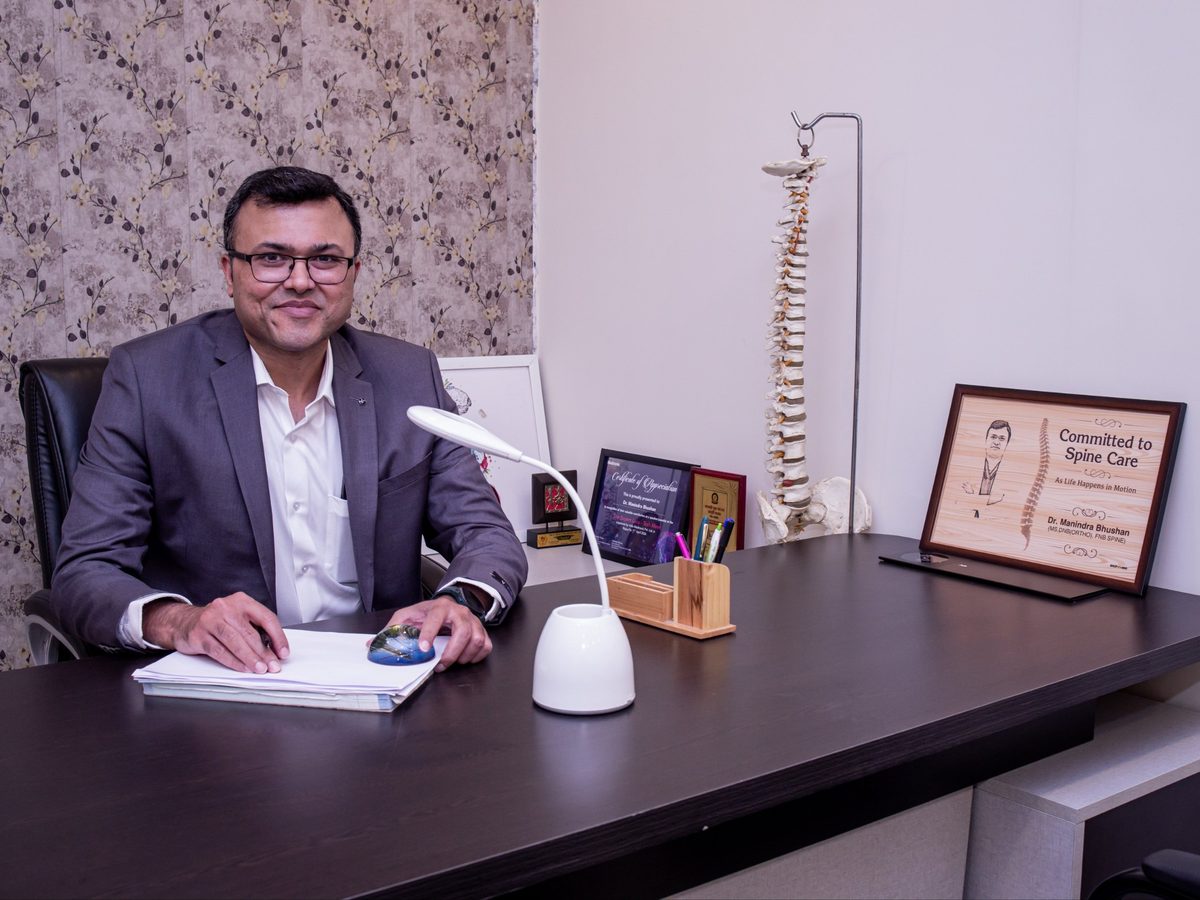
MBBS · MS (Ortho) · DNB (Ortho) · FNB Spine Surgery · AOSpine Fellow
Fellowship-trained at Ganga Hospital, Coimbatore, Dr. Bhushan treats back and neck conditions — from sciatica and slipped disc to complex deformity and spinal tuberculosis. Treatment starts non-surgical; surgery is recommended only where it is genuinely the better option.
Two locations, Monday to Saturday. Sunday closed. Appointments on WhatsApp or by phone at 083491 10057.
Inpatient care, spine surgery, spinal trauma and emergencies — with ICU, anaesthesia and imaging support on site.
Consultation, MRI and CT review, spine injections and post-operative follow-up. By appointment.
The Avanti Vihar centre itself opens earlier for ultrasound and fetal medicine. The times above are when Dr. Bhushan is personally available at each location.
Dr. Manindra Bhushan completed his MBBS and MS in Orthopaedics at Kasturba Medical College, Manipal, followed by the DNB in Orthopaedics. He then trained exclusively in spine surgery through the two-year FNB Spine Surgery fellowship at Ganga Medical Centre & Hospitals, Coimbatore, and the AOSpine India Fellowship at Sir Ganga Ram Hospital, New Delhi.
He has been a Consultant Spine Surgeon at Shree Narayana Hospital, Raipur since 2018. Most back and neck problems he sees are managed without surgery. When an operation is needed, he explains the options, the expected recovery and the risks in plain language so that patients and families can decide with full information.
His research on navigation-assisted pedicle screw placement in complex spinal deformity is published in the European Spine Journal, and he serves as a reviewer for Spinal Cord Series and Cases.
Every plan starts with a careful examination and a review of your MRI or CT. Surgery is one option among several, not the default.
Low back pain with or without leg pain, tingling or numbness. Most cases settle with the right medication, physiotherapy and activity advice. Persistent sciatica may respond to a targeted nerve-root injection before surgery is ever considered.
A lumbar or cervical disc pressing on a nerve. The majority improve without an operation over weeks. Surgery — usually microdiscectomy or endoscopic discectomy — is advised for progressive weakness, bladder or bowel symptoms, or pain that has not settled.
Narrowing of the spinal canal, typically in older adults, causing leg pain or heaviness on walking that eases on sitting. Treated with medication and exercise first; decompression surgery restores walking distance when symptoms limit daily life.
Compression of the spinal cord in the neck can cause clumsy hands, imbalance and loss of fine movement. Unlike simple neck pain, myelopathy often progresses and is time-sensitive. Options include ACDF, cervical disc replacement and laminoplasty.
Forward slip of one vertebra over another, producing back pain and leg symptoms. Many patients do well with strengthening and pain management; fusion surgery stabilises the segment when the slip causes nerve compression or instability.
Sideways or forward curvature of the spine in adolescents and adults. Assessment covers curve progression, balance and pain. Deformity correction, where needed, uses intraoperative CT navigation for accurate screw placement.
Back pain with fever, night sweats or weight loss warrants early evaluation. Management includes biopsy for diagnosis, supervised anti-tubercular treatment and bracing, with surgery for deformity or neurological deficit.
Injuries from falls and road accidents, and osteoporotic compression fractures in older adults. Treatment ranges from bracing to fixation surgery and vertebral augmentation, delivered with hospital ICU support at Shree Narayana Hospital.
Peer-reviewed papers in spine surgery and orthopaedics.
Podium presentations include the Association of Spine Surgeons of India annual conference (2017) and the TNOA Golden Jubilee conference (2017), on navigation-based pedicle classification validated across 455 screws placed with the AIRO intraoperative CT scanner.
Shree Narayana Hospital, Pandri: 10 AM to 5 PM. Shivam Fetomed & Spine Centre, Avanti Vihar: 5 PM to 8 PM. Monday to Saturday; Sunday closed. Book on WhatsApp or call 083491 10057.
Usually not. Most disc herniations improve with physiotherapy, medication and time. Surgery is considered for progressive weakness, bladder or bowel involvement, or pain that has not settled after an adequate trial of non-surgical treatment.
All spine MRI and CT films and reports, X-rays, previous prescriptions and discharge summaries, and a list of your current medicines. Please bring the actual films or the CD, not only the written report.
Yes — including microscope-assisted and endoscopic discectomy, minimally invasive decompression and fusion, and navigation-assisted screw placement using intraoperative CT for complex and revision cases.
Operations and inpatient care are at Shree Narayana Hospital, Pandri, Raipur, which has ICU, anaesthesia and on-site imaging support.
Yes. Bring your MRI or CT and any surgical advice you have received. You will get a clear opinion on whether surgery is needed now, can wait, or can be avoided.